Septic to Sewer Conversion Cost (Suffolk County, 2026)
By TNTSEO United
Reviewed by Bernie Colletti, Colletti Sewer & Drain
Last updated: August 2026
TL;DR: Colletti's preliminary planning range for a Suffolk County septic to sewer conversion is $5,000 to $15,000 or more, not a quote. A site inspection and district check establish the price. The total can include permits, the lateral from the house to the main, a connection fee, old system abandonment, inspections, and restoration. Current county and state septic grants are for eligible I/A OWTS upgrades, not an automatic sewer-connection benefit (Suffolk County Government). Sewer expansion projects can change the math for eligible properties. We are a local Suffolk County cesspool, septic, and sewer company. We answer 24/7, inspect before quoting, and give a clear price range before dispatch. Call 631-644-4939.
What does septic to sewer conversion cost?
In brief: Colletti's preliminary Suffolk County planning range is $5,000 to $15,000 or more, not a phone quote. We must check the lateral route, main depth, local fees, old system abandonment, and restoration at the property before pricing the conversion.
A conversion is not one standardized job. The first driver is the distance between the house plumbing and the public main. The second is trench depth and what crosses the route, including driveways, mature trees, irrigation, utilities, and retaining walls. The third is the town or sewer district permit path and any property-specific connection charge. The fourth is restoring everything opened for the work.
Conditions differ across Babylon, Brookhaven, Huntington, Islip, Smithtown, Riverhead, Southampton, Southold, East Hampton, and Shelter Island. We inspect before recommending work and do not push replacement before diagnosing the system and route.
What you are actually paying for, line by line
In brief: We itemize the permit path, sewer lateral, connection charge, abandonment, inspections, restoration, and any interior plumbing work so a homeowner can see what is included. Property-specific government fees and requirements must be confirmed directly with the Suffolk County DPW Sewer Permits Office or the sewer district serving the parcel.
| Cost component | What it covers | Typical range | What moves the price |
|---|---|---|---|
| Permits and applications | Local applications and contractor permit handling | Set after review; confirm with the Suffolk County DPW Sewer Permits Office or the serving sewer district | Jurisdiction, reviews, and required plans |
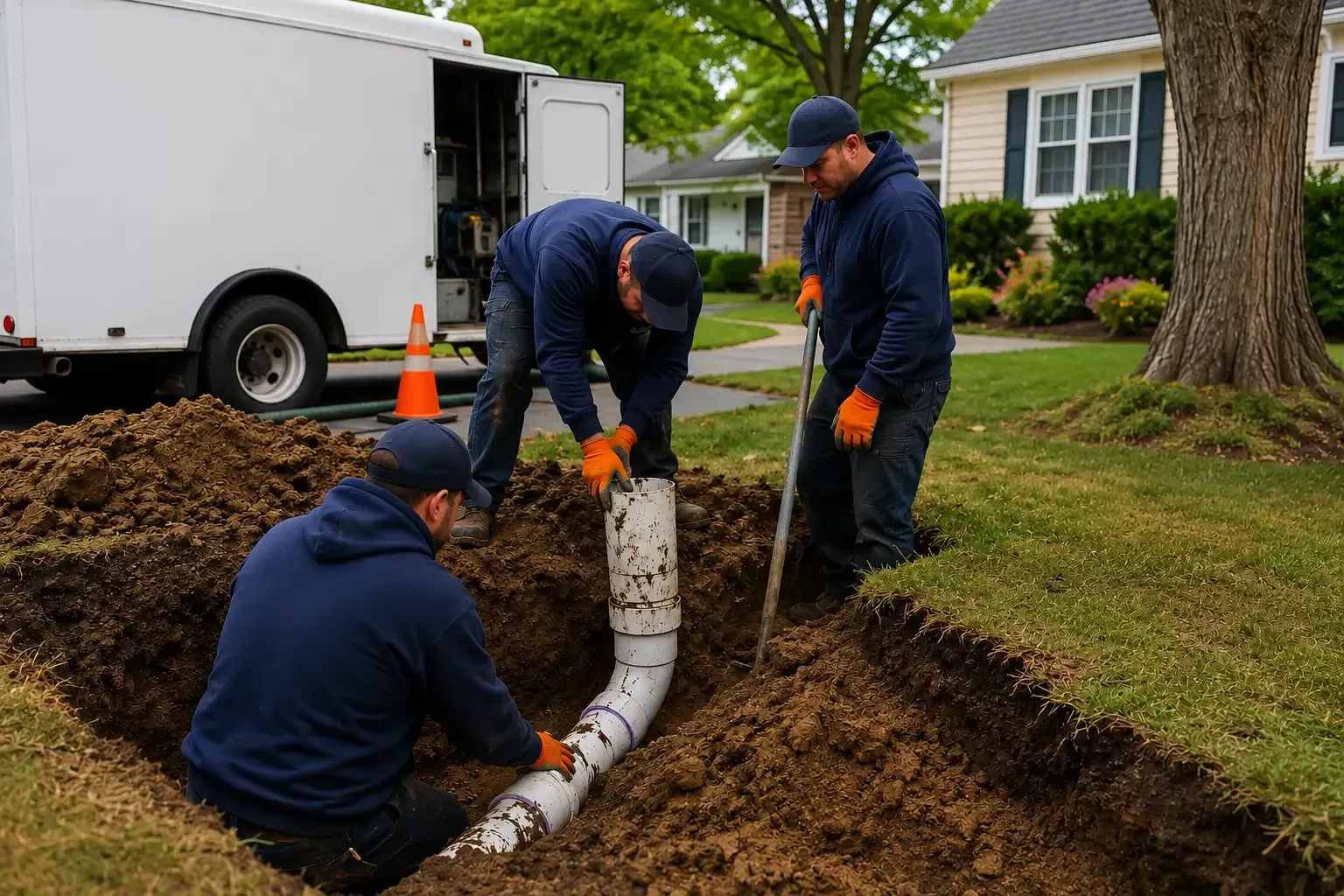
| Sewer lateral installation from house to main | Excavation, pipe, bedding, connection, and trench backfill | Quoted after site inspection and permit review; confirm requirements with the Suffolk County DPW Sewer Permits Office | Length, depth, soil, utilities, and obstacles |
| Connection or tap-in fee | The charge, if any, imposed for the specific connection | Quoted for the parcel by Suffolk County DPW or the serving sewer district | District, parcel status, and project rules |
| Septic tank or cesspool abandonment | Pump-out, removal or clean fill, collapse where required, and documentation | Quoted after system review; confirm closure requirements with Suffolk County DPW and the Suffolk County Department of Health Services | Structure type, access, volume, and disposal |
| Inspection fees | Required public inspections and final approvals | Set after permit review based on the proposed work; confirm with Suffolk County DPW | Agency, inspection count, and reinspection |
| Surface restoration | Driveway, walkway, lawn, and irrigation repair | $500 to $2,000, national planning range (The Septic Guide) | Materials, disturbed area, and finish standard |
| Optional interior plumbing changes | Rerouting building drains to reach the new lateral | $0 to $3,000, national planning range (The Septic Guide) | Existing drain location and building access |
Permit, connection and inspection figures above are set by the county or by the sewer district serving your parcel. Confirm the amounts that apply to your property with the Suffolk County DPW Sewer Permits Office, and check Suffolk County DPW for connection-status and billing questions.
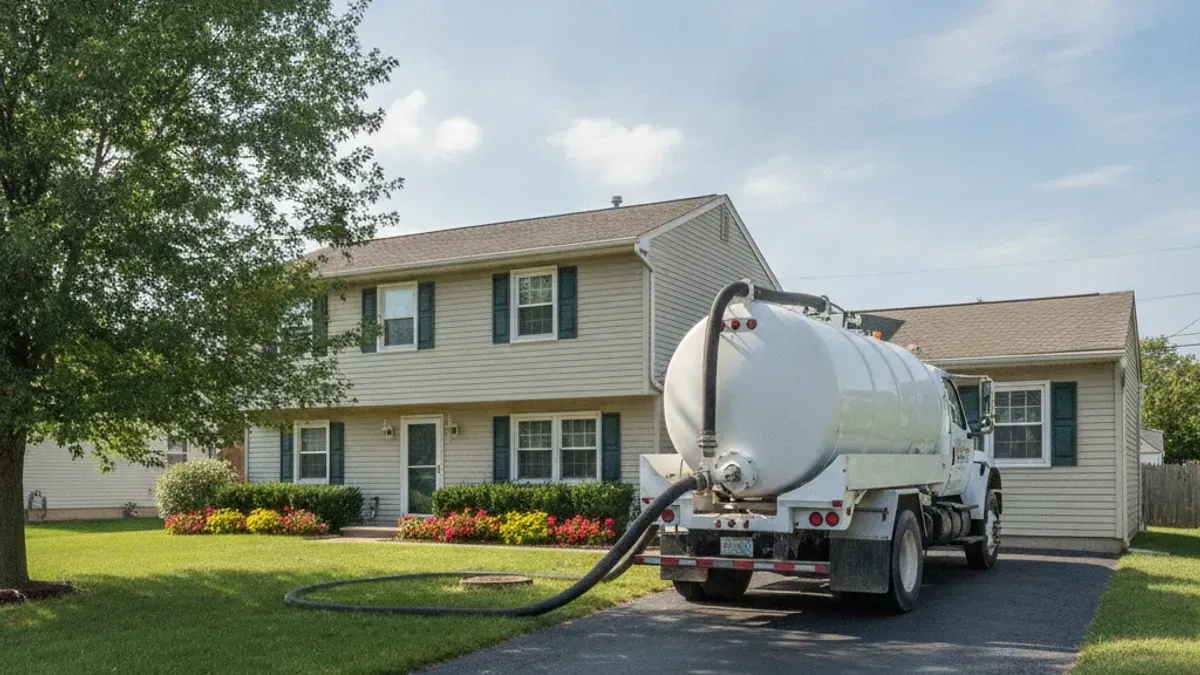
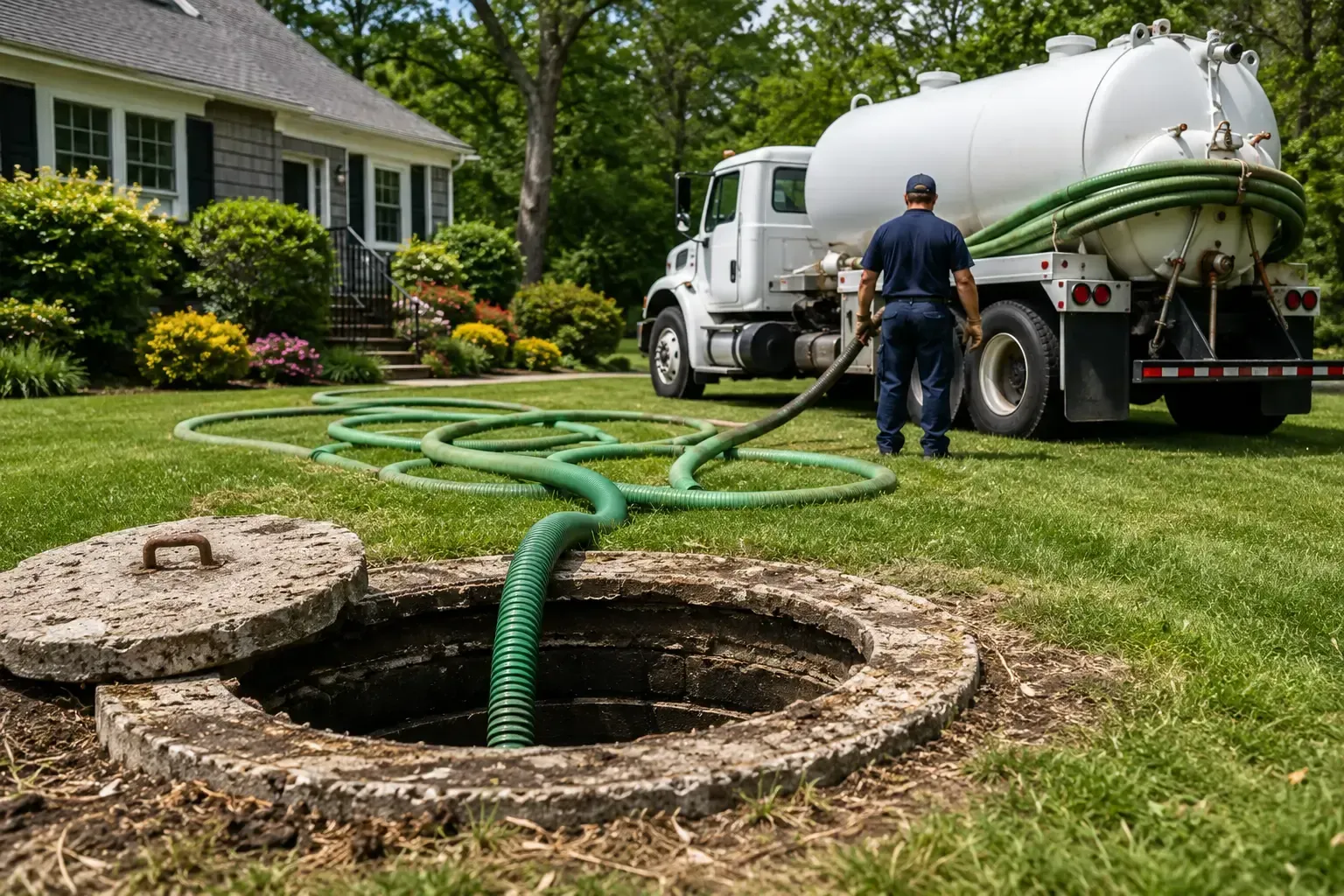
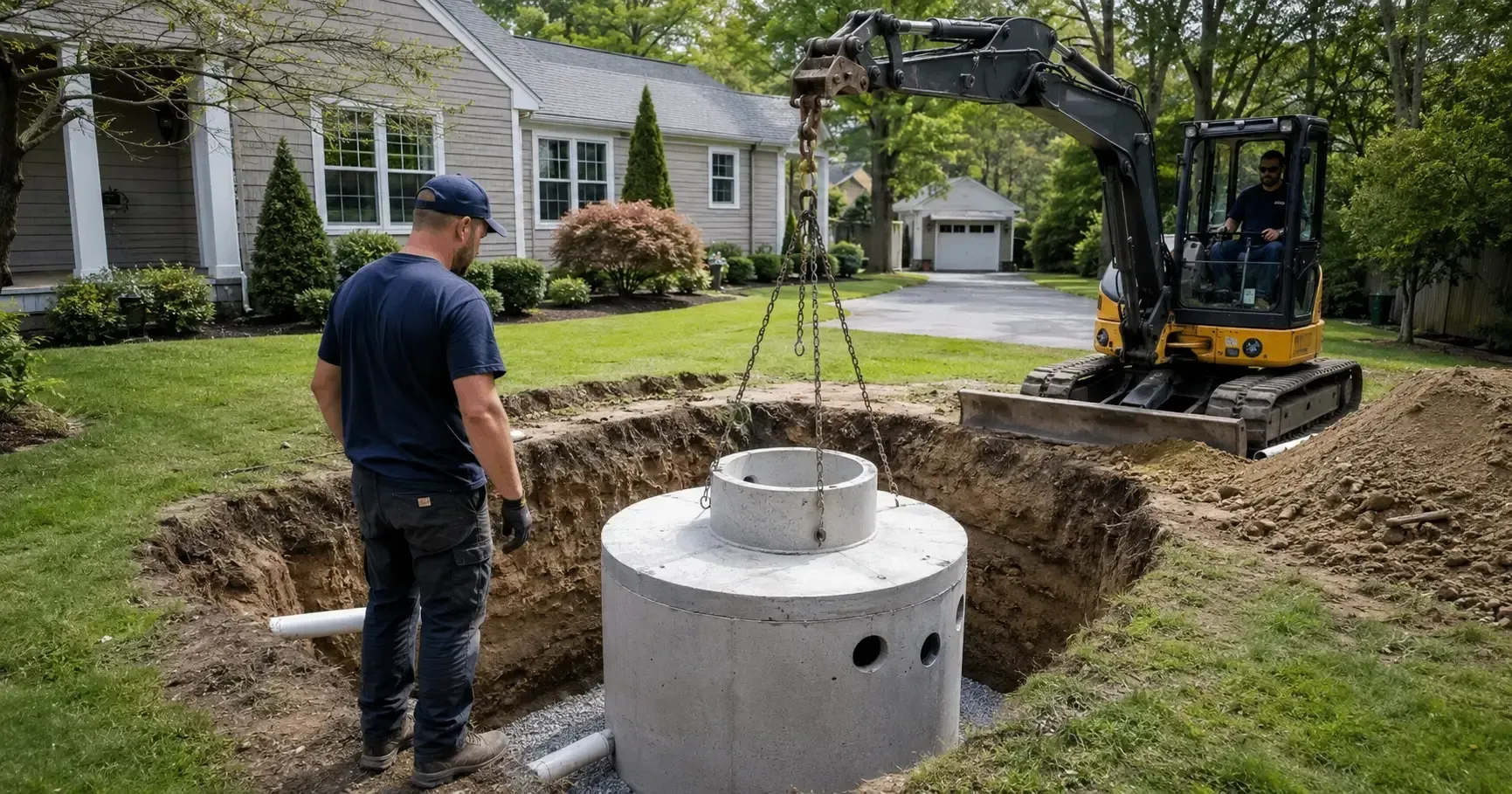
Abandonment is not optional paperwork. Suffolk County's certification requires the contractor to locate the system components, have liquid waste removed by a licensed hauler, and remove the structure or fill it with clean backfill, including collapse of corbelled block domes where present (Suffolk County Department of Health Services). Leaving an empty structure intact can create a future collapse hazard. See what cesspool pumping costs for the pump-out side of the work.
When is connecting to the sewer mandatory, and when is it your choice?
In brief: We verify the parcel and district before answering because a public main near the street does not by itself settle the question. Suffolk County law requires connection when county sewage works are available and accessible, and a property inside a district generally has one year after official notice to connect (Suffolk County Code).
Ask Suffolk County Department of Public Works and the local district to confirm the property status, available connection, and notice date. The county lists sewerconnectionstatus@suffolkcountyny.gov for connection-status questions (Suffolk County DPW). Since January 1, 2026, county sewer districts have been consolidated, and connected properties receive a separate sewer bill under the county's billing transition (Suffolk County DPW).
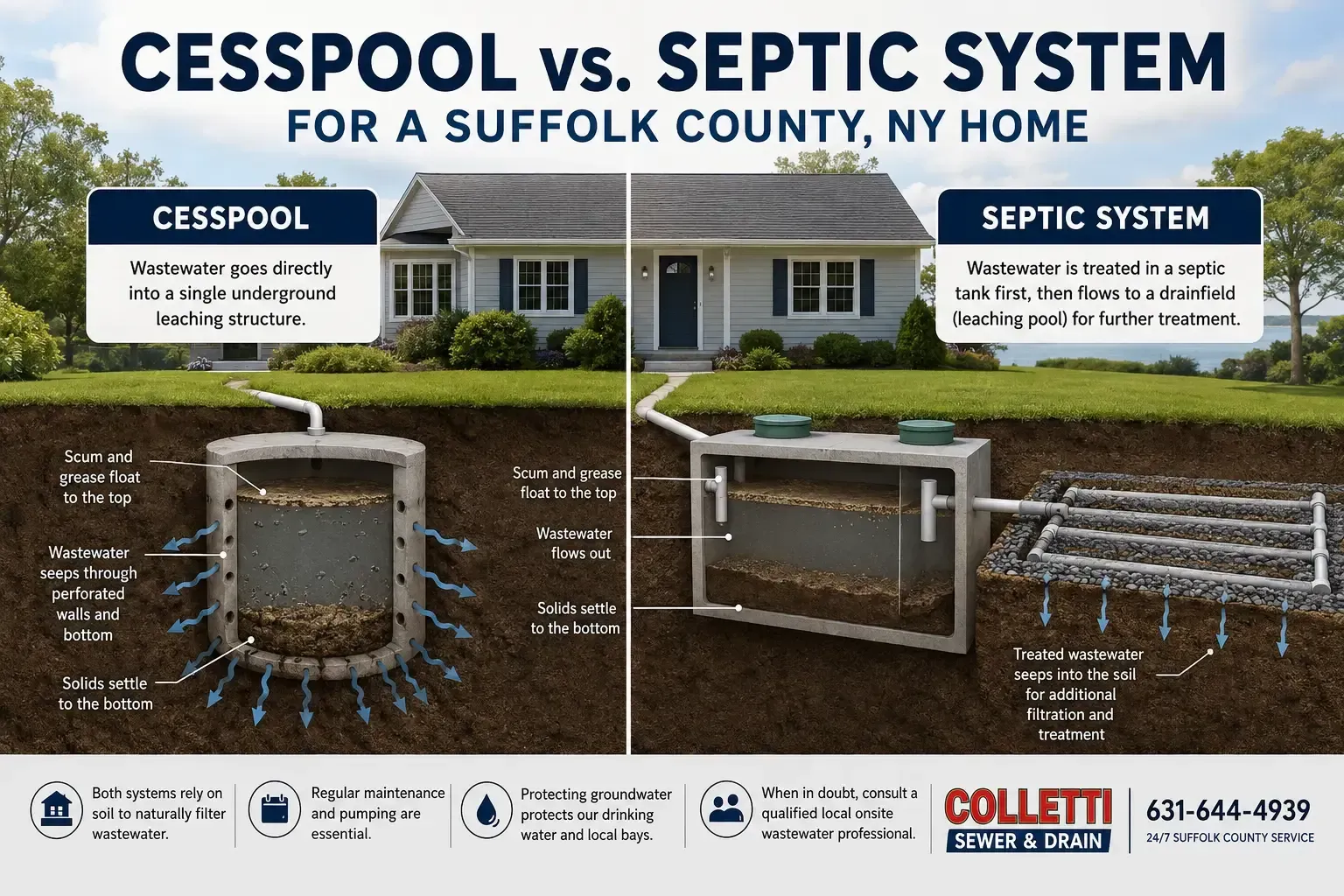
A failed cesspool cannot be replaced in kind after July 1, 2019, and its replacement needs Department of Health Services approval (Suffolk County Sanitary Code, Article 6). For applications on or after July 1, 2021, an I/A OWTS is required for new or expanded single-family homes and major reconstruction where onsite disposal is permitted. Major reconstruction uses a threshold greater than 50 percent of the structure's market value, with listed exclusions, so confirm the project's classification with the county (Suffolk County Sanitary Code, Article 6).
Suffolk County grant and reimbursement programs
In brief: We tell homeowners to separate septic-upgrade aid from sewer-connection pricing. Suffolk County currently lists up to $20,000 through its Septic Improvement Program, while New York State assistance can reimburse up to 75 percent of eligible costs with a $25,000 cap, for a potential combined $45,000 on an approved I/A OWTS project (Suffolk County Government).
Those figures come from the county's August 2026 portal and process overview. County funds go directly to an approved installer, while the state share may be paid directly or reimbursed (Suffolk County Government). County permit fees are ineligible, and owners remain responsible for engineering, design, landscaping, and long-term maintenance unless another program pays them (Suffolk County Government).
The key limitation is simple: the county portal says the property cannot already be connected to sewer or be in a proposed sewer area. These grants fund eligible onsite nitrogen-reducing systems, so do not assume they will pay for a public sewer connection. Never rely on a promised award until the administrator approves the application.
The Community Development Corporation of Long Island lists a low-interest septic replacement gap loan, but its current public program page does not publish the interest rate or repayment term. Ask CDLI for the terms that apply before using the loan in a project budget. East Hampton publishes up to $20,000 in its Water Protection District, up to $15,000 elsewhere, and up to $20,000 for eligible low-to-moderate-income applicants (Town of East Hampton). Southampton lists a $20,000 maximum and excludes costs paid by other grants (Town of Southampton).
The Peconic Estuary Partnership lists an I/A OWTS maintenance grant up to $500 per year (Peconic Estuary Partnership). Suffolk County identifies the voter-approved one-eighth percent sales tax as a water-quality funding source (Suffolk County Government). Rules and eligibility change. This is not legal or financial advice, so confirm terms with Suffolk County Department of Health Services and each administrator.
Sewer expansion in Suffolk County, and the I/A OWTS alternative
In brief: We first check whether a funded sewer project reaches the parcel because an eligible project connection can cost very differently from a private one-off lateral. When no public sewer is available or planned, an approved I/A OWTS is the main nitrogen-reducing onsite alternative, with its own installation and continuing maintenance costs.
Suffolk County's proposed 2026 to 2028 capital program identifies more than $1.4 billion in sewer infrastructure, contingent in part on outside funding (Suffolk County Government). The Suffolk County Coastal Resiliency Initiative says eligible Forge River Watershed properties can receive the connection, onsite equipment, old-system abandonment, and restoration at no cost to the homeowner under that project (Suffolk County Government). Eligibility and project windows must be verified before treating that benefit as part of a budget.
An I/A OWTS treats wastewater onsite and reduces nitrogen before discharge to the soil. The Peconic Estuary Partnership publishes a $20,000 to $30,000 equipment and installation range before engineering and design, with final cost dependent on the site (Peconic Estuary Partnership). Suffolk County's May 2026 guide says the required professional operation and maintenance contract is about $300 to $600 per year (Suffolk County Government).
The county's comprehensive wastewater plan reported roughly 74 percent of Suffolk as unsewered (Suffolk County Government). Sandy soil, a sole-source aquifer, high groundwater, and many older cesspools connect wastewater policy to drinking-water and surface-water protection. If sewer is unavailable, compare the approved I/A path with the new cesspool installation cost discussion, remembering that failed cesspools cannot be replaced in kind.
How to choose an honest Suffolk County conversion contractor
In brief: We recommend choosing a contractor who visits the property before giving a number, identifies the agency and permit path in writing, includes documented abandonment, defines restoration, and treats every grant as pending until approval. A flat phone price cannot account for a buried route that has not been inspected.
Require a site visit and a written scope showing the lateral route, depth assumptions, and exclusions.
Ask who obtains each permit, schedules each inspection, and closes the permit after connection.
Confirm that pumping, removal or fill, collapse where required, and abandonment documentation are included.
List driveway, walkway, lawn, irrigation, and interior plumbing restoration separately.
Reject promises of a grant award before written program approval.
Red flags include skipping the abandonment permit, hiding restoration outside the scope, or quoting a flat price without seeing the site. We inspect before quoting and diagnose before recommending replacement. For an existing pipe, see our sewer line repair cost guide.
Frequently asked questions
in brief: We answer the eight questions Suffolk County homeowners most often ask about total cost, mandatory connection notices, old-system abandonment, current septic grants, sewer availability, I/A systems, project timing, and the financial choice between a public connection and an onsite replacement. Each property still needs a parcel-status check and site inspection.
How much does it cost to convert from septic to sewer?
Colletti's preliminary planning range for a Suffolk County residential conversion is $5,000 to $15,000 or more, not a quote. A site visit and district fee check are essential because distance, trench depth, obstacles, abandonment, permits, and restoration create the spread. A written quote should itemize each component.
Do I have to connect to the sewer if it becomes available on my street?
We verify the parcel because Suffolk County law requires connection when county sewage works are available and accessible, and facilities within a county sewer district generally must connect within one year after the county gives official notice that the works are ready (Suffolk County Code). Ask the district whether your property has received that notice.
What happens to my old septic tank or cesspool when I connect to the sewer?
We locate every component, use a licensed hauler to pump liquid waste, then remove the structure or fill it with clean backfill and collapse corbelled block domes, because Suffolk County requires documented abandonment before final signoff (Suffolk County Department of Health Services). The completed connection also requires the applicable sewer permit closure.
Are there grants to help pay for septic work in Suffolk County?
We direct eligible homeowners to current onsite-upgrade programs, including a county grant of up to $20,000 and a state reimbursement of up to 75 percent of eligible costs capped at $25,000, but these funds do not automatically cover a sewer connection (Suffolk County Government). Confirm eligibility and approval before signing a funded scope.
How do I find out if my Suffolk County property can connect to a sewer?
We start with Suffolk County DPW and the sewer district serving the address, using the tax map number and a survey to confirm the district, available connection, permit path, and active notice, then use sewerconnectionstatus@suffolkcountyny.gov when a county bill or letter leaves the connection status unclear (Suffolk County DPW). Do not rely only on a nearby manhole.
What is an I/A OWTS and when do I need one instead of a sewer connection?
We describe an I/A OWTS as an advanced onsite system designed to reduce nitrogen before effluent reaches the soil, used where an onsite system is permitted and public sewer is unavailable, with the exact new-home, expansion, and major-reconstruction triggers determined under Article 6 (Suffolk County Sanitary Code). It also requires professional operation and maintenance.
How long does a septic to sewer conversion take?
We set the field schedule after inspecting the route. The full timetable depends on application review, inspections, and scheduling through the Suffolk County DPW Sewer Permits Office or the serving sewer district. Deep mains, utility conflicts, hardscape, or additional review can extend it.
Is it cheaper to connect to the sewer or replace the septic system?
We compare property-specific net costs because either option can be cheaper: sewer depends on the lateral, connection fees, abandonment, and restoration, while an I/A replacement depends on design, site conditions, available grants, and ongoing maintenance, with project-specific funded sewer work sometimes changing the result completely. I/A grants do not automatically transfer to sewer work.
Talk to a Suffolk County sewer and septic crew
In brief: We provide 24/7 cesspool, septic, sewer, and drain service across Suffolk County, begin every conversion quote with a free onsite inspection, and trace the proposed lateral route before stating what the abandonment and connection work should include for the homeowner. Call 631-644-4939 or use our contact form.
We will explain what we find, give a clear range before dispatch, and separate required work from optional restoration. Schedule Suffolk County service.