Septic Inspection Cost (Suffolk County, 2026)
Reviewed by Bernie Colletti, Colletti Sewer & Drain
Last updated: August 2026
TL;DR: A septic inspection cost in Suffolk County runs about $300 to $650 for the pre-purchase inspection most home sales need, which matches our own published Suffolk County range and the national guides. A basic visual and dye test inspection runs $300 to $425 with us, pumping during the inspection adds $300 to $500, and a sewer camera scan brings the total to $450 to $650. The price moves on four things: what type of system you have, how buried the covers are, whether pumping is included, and whether you need a camera. On Long Island this is a normal line item in a house sale, not a rural edge case. We are Colletti Sewer & Drain. Call 631-644-4939 for a clear range before we come out.
What does a septic inspection cost?
In brief: Expect roughly $300 to $650 for a pre-purchase septic or cesspool inspection in Suffolk County, and $150 to $450 for a routine maintenance inspection. The pre-purchase band is where our own published Suffolk County pricing and the national cost guides agree. The routine maintenance band is the national guides' figure, not ours. The spread inside both comes down to system type, access, pumping, and add-ons.
The published figures are wide, and most of them are national rather than local. Here is the honest spread with the source type named, so you can judge each one:
- Colletti, Suffolk County: $300 to $650 for a real estate cesspool inspection, published on our own real estate inspection guide.
- HomeGuide (national cost guide, not Suffolk specific): $150 to $450 for routine maintenance, $300 to $650 for a real estate transaction, national average $290, minimum $100, maximum $1,100.
- The Septic Guide (national industry cost guide, not Suffolk specific): $150 to $300 basic, $300 to $500 full, $300 to $650 for a real estate transaction inspection.
- Angi (national cost guide, not Suffolk specific): $100 to $1,300 overall with a $550 average, and a New York state figure of $680. That is a state average, not a Suffolk County price.
No Suffolk County agency publishes an inspection price, because a private inspection is not a county service. Anyone showing you a single flat "Suffolk County price" with no site questions is guessing. Four things actually move the number:
- System type. A cesspool, a septic tank with a leaching pool, and an I/A OWTS are three different jobs.
- Access. Buried covers mean digging. Angi puts that add at $50 to $250 nationally.
- Pumping. Included or not, and it usually should be. More on that below.
- Add-ons. A camera scan, a dye test, or locating a system nobody has records for.
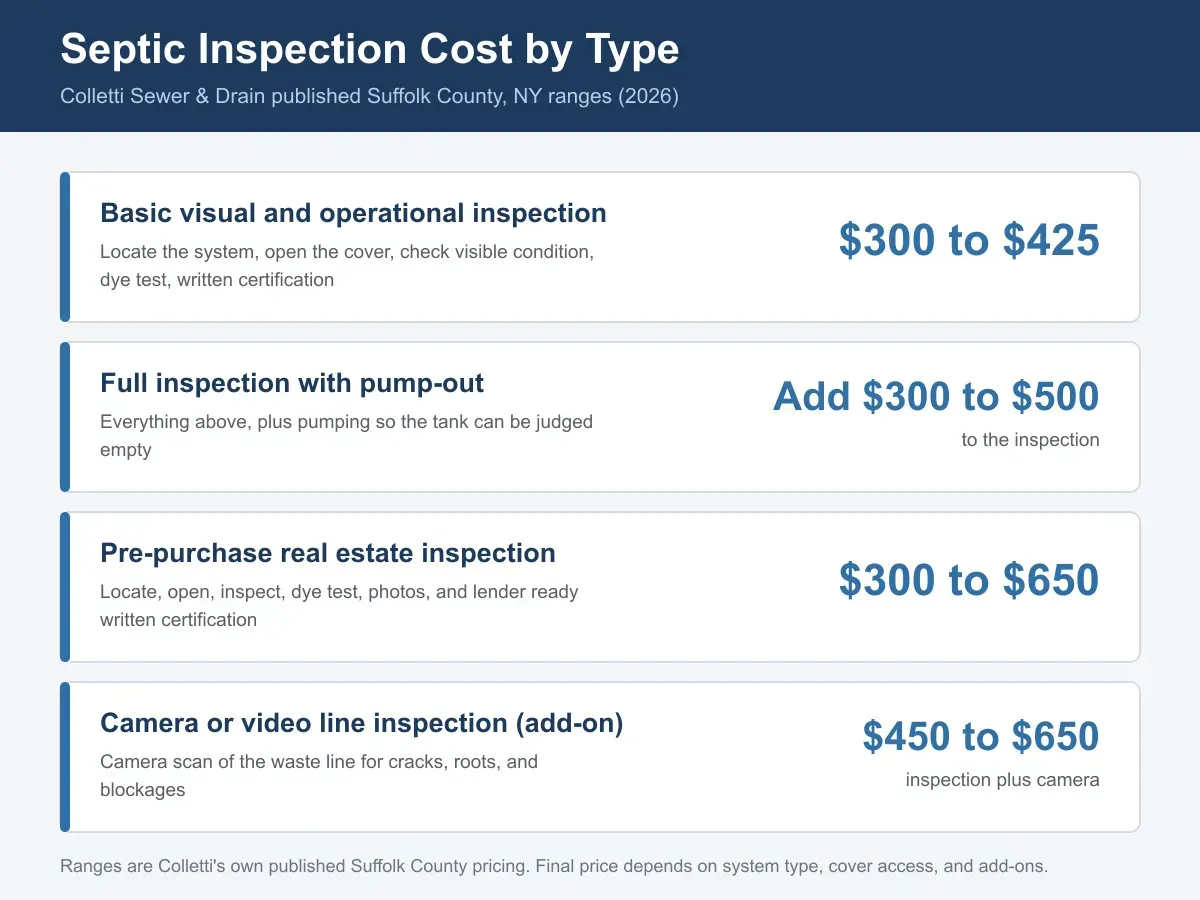
Septic and cesspool inspection costs by type
In brief: A basic visual and dye test inspection runs $300 to $425 in Suffolk County, a camera scan brings it to $450 to $650, and pumping during the inspection adds $300 to $500. Those are our own published Suffolk County ranges. National guides put a standalone camera add-on at $125 to $500 and a standalone dye test at $150 to $250.
| Inspection type | What is included | Typical price range | When you need it |
|---|---|---|---|
| Basic visual and operational inspection | Locate the system, open the cover, check visible condition, dye test, written certification | $300 to $425 (our published Suffolk County range) | Peace of mind, or a first look before you list |
| Full inspection with pump-out | Everything above, plus pumping so the tank can be judged empty | Add $300 to $500 to the inspection (our published Suffolk County range) | Any time solids or liquid level block a proper view |
| Pre-purchase real estate inspection with written report | Locate, open, inspect, dye test, photos, and lender ready written certification | $300 to $650 (our published Suffolk County range, and the same band HomeGuide and The Septic Guide report nationally) | Buying or selling a home on a cesspool or septic system |
| Camera or video line inspection (add-on) | Camera scan of the waste line for cracks, roots, and blockages | $450 to $650 for inspection plus camera (our Suffolk County range). National guides price the add-on alone at $125 to $500 (HomeGuide, The Septic Guide) | Suspected line damage, root intrusion, or repeat backups |
| Dye test (add-on) | Dye traced through the system to confirm where the water actually goes | Included in our basic inspection. National guides price it separately at $150 to $250 (The Septic Guide) | Confirming absorption and spotting surfacing |
| System locate or as-built retrieval (add-on) | Finding a buried system on site, or pulling the county as built record | Locating is included in our inspection. We found no published fee for county record retrieval, so ask the Office of Wastewater Management directly | Older properties with no records and no visible covers |
| Percolation test for a replacement design (separate service) | Soil testing performed for a design professional as part of a new system design | Priced per site by the design professional. No reliable published standard range exists, so treat any flat quote with suspicion | Only when a system is being replaced or redesigned. This is not an inspection |
Rush turnaround, when a closing date is tight, adds $100 to $200 with us.
The pre-purchase version costs more for three reasons: it carries documentation a lender and two attorneys will read, it carries liability the routine version does not, and it usually includes pumping. That last point matters more than people expect. HomeGuide's guidance is blunt: never allow an inspector to inspect the system without pumping the tank first, because a full tank hides cracks, blockages, and baffle damage. For what that pumping costs on its own, see what cesspool pumping costs.
What the inspector actually checks, and how it differs for a cesspool
In brief: An inspection locates the system, opens the covers, measures sludge and scum, checks the tank and baffles, looks for surfacing or ponding over the leaching area, runs a dye or flow test, and ends in a written report. On a cesspool there is no separate tank to measure, so structural condition carries more of the verdict.
The national scope is consistent. HomeGuide lists opening and inspecting the tank, pump tank, and distribution box, evaluating sludge, scum, and effluent levels, assessing the filter, lid, and baffles, looking for leakage, cracks, or corrosion, evaluating the drain field for standing water, and confirming pumps and controls work. That is what a real inspection looks like anywhere.
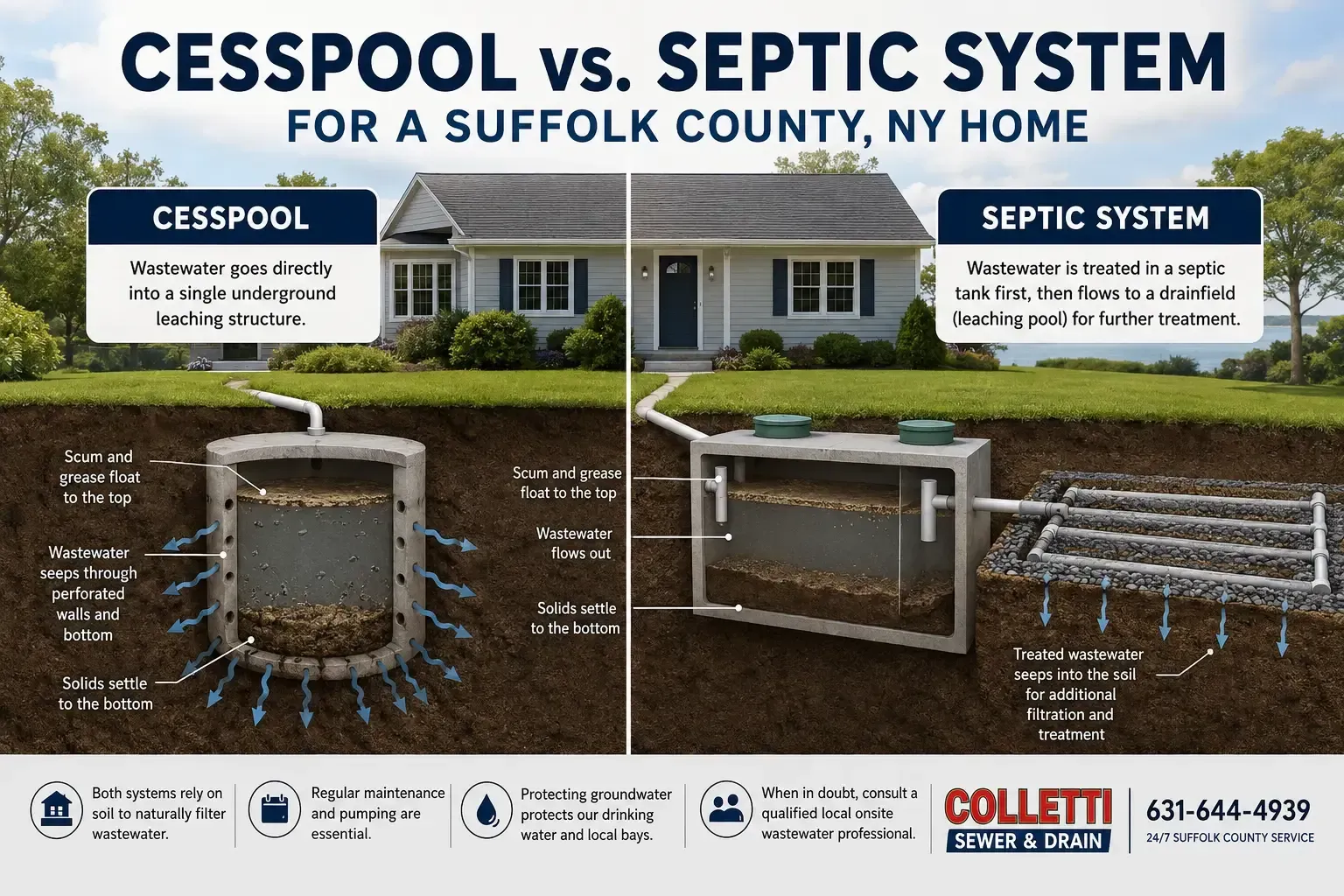
Long Island changes the emphasis. Suffolk County describes a cesspool as a single buried chamber that receives raw waste and lets untreated effluent leach into the surrounding soil, with no separate settling tank, and some older ones built from cement block or brick (Suffolk County Department of Health Services, Septic Improvement Program FAQ). There is less to measure and more to judge: how sound the sidewalls are, how badly the walls have blinded over, and whether the structure is holding its shape. A collapsing cesspool is a real hazard here, not a talking point, and it is one reason nobody should be lifting their own lids or walking on soft ground over an old structure. For the full step by step of a transaction inspection, read what happens during a cesspool inspection before you buy or sell.
Who pays for the septic inspection in a Suffolk County home sale?
In brief: Who pays is a negotiated contract term, not a Suffolk County rule. In many local transactions the buyer pays as part of due diligence, and sellers often pay for a pre-listing inspection so they can fix anything on their own timeline instead of under a closing deadline.
Both patterns are normal here. A buyer paying keeps the report independent. A seller paying gets the surprise out of the way before an offer is on the table, which is usually the cheaper of the two outcomes. Whichever way your deal goes, get it in writing: who pays, what scope is included, whether pumping is part of it, and how fast the report is delivered. This is not legal advice, so confirm the contract terms with your attorney.
One thing worth clearing up: the county's inspection line is not this. Suffolk County's Office of Wastewater Management does carry out inspections, but those are construction inspections tied to permitted work on a system, carried out under Article 6 of the Suffolk County Sanitary Code and the county's Residential Standards (Suffolk County Department of Health Services). They are scheduled around a permit, not around your closing date. A pre-purchase inspection for a home sale is a private service you hire yourself.
What a failed inspection means for your closing
In brief: A failed system does not automatically kill a deal, but it does move the conversation to repair, replacement, price, or walking away, and in Suffolk County a failed cesspool cannot simply be swapped for another cesspool. Replacement or upgrade work needs Suffolk County Department of Health Services approval before anything is installed.
Suffolk County's Residential Standards define an OWTS Replacement as the abandonment or removal of an existing individual sewerage system or cesspool and the installation of a new individual sewerage system, and define an individual sewerage system as one that includes a septic tank or an I/A OWTS tank ahead of the leaching structure. In practice that means a replacement puts a real settling tank in front of the leaching structure. The same standards state that permits are required for all new sewage disposal systems, with site plan approval before construction starts.
Local rules can be stricter than the county's. Several East End towns, East Hampton and Shelter Island among them, have adopted their own local laws requiring a nitrogen-reducing I/A system in situations where the county alone would not, and some tie that trigger to a property transfer or an expansion. The nitrogen standard those laws point at is the county's own I/A threshold of 19 mg/l total nitrogen. Local codes change, and a town and the village inside it can differ, so check the code for your specific property with the town or village clerk as well as the county before you agree to anything at the closing table.
County and state grant programs exist to offset the cost of an I/A upgrade. Amounts and eligibility change, so confirm the current numbers on the county's Septic Improvement Program page rather than trusting a contractor's figure, including ours.
"A failed inspection is not a sales opportunity, it is a diagnosis. We open the system, we show you photos, and we tell you what we actually found. If somebody inspects your cesspool and quotes you a replacement in the same visit without evidence, get a second opinion before you sign anything."
Bernie Colletti, Colletti Sewer & Drain
For what a replacement project involves, see new cesspool installation cost.
How to choose an honest Suffolk County inspection company
In brief: Hire a company that gives you a clear price range before dispatch, opens the covers instead of doing a drive-by, delivers a written report with photos, works Suffolk County every week, and never quotes a replacement without evidence. Those five things separate a real inspection from a sales call.
Look for real Suffolk County experience across Babylon, Brookhaven, Huntington, Islip, Smithtown, Riverhead, Southampton, Southold, East Hampton, and Shelter Island, a scope you can read before you book, and a report both sides of the deal can hand to an attorney or a lender.
Walk away from a flat online price quoted with no questions about your system, an inspection that never opens a cover, and a company that inspects and then quotes a replacement in the same breath with nothing to show you. Be careful with ultra low quotes too. A $150 inspection is usually skipping the camera scan, the documentation, or both.
Frequently asked questions
How much does a septic inspection cost?
A septic inspection costs about $300 to $650 for the pre-purchase version most home sales need, and $150 to $450 for a routine maintenance inspection. The pre-purchase band is both our own published Suffolk County pricing and what the national guides HomeGuide and The Septic Guide report. The routine maintenance band is theirs, not ours. Angi puts the national range at $100 to $1,300 with a $550 average. System type, cover access, pumping, and add-ons decide where you land.
How much does a cesspool inspection cost on Long Island?
Our published Suffolk County ranges are $300 to $425 for a basic cesspool inspection with a dye test and written certification, and $450 to $650 when a sewer camera scan is included. Pumping during the inspection adds $300 to $500, and a 24 hour rush turnaround adds $100 to $200. We give you the range before we dispatch rather than after we are in your driveway.
Is a septic inspection required when you sell a house in Suffolk County?
Suffolk County does not impose a countywide inspection mandate on every home sale, but in practice most financed transactions involve some form of inspection or certification because the lender or the contract asks for it. Some villages and East End towns have their own rules that are stricter than the county's. Confirm what applies to your property with your attorney and with the Suffolk County Department of Health Services.
Who pays for the septic inspection, the buyer or the seller?
Who pays is a negotiated contract term, not a county rule. In many Suffolk County transactions the buyer pays as part of due diligence, which keeps the report independent. Sellers often pay for a pre-listing inspection instead, so any problem surfaces on their timeline rather than three days before closing. Put the scope, the payer, and the turnaround in writing, and confirm the terms with your attorney.
Does a septic inspection include pumping the tank?
Sometimes, and for a transaction inspection it usually should. A full tank hides cracks, baffle damage, and blockages, which is why HomeGuide advises never letting an inspector inspect a system without pumping it first. Many companies charge pumping separately, and our published Suffolk County range adds $300 to $500 for pumping during the inspection. Always ask whether the quote includes it before you book.
How long does a septic inspection take?
Plan on one to three hours on site. HomeGuide puts a septic inspection at one to three hours depending on the type, the system's complexity and accessibility, and what the inspector finds, with a written report typically delivered by the end of the next business day. A basic visual check is at the short end, and a full transaction inspection with pumping and a camera scan is at the long end.
What happens if the septic system fails inspection before closing?
You have four practical paths: repair, replace, renegotiate the price, or walk away. In Suffolk County a failed cesspool cannot simply be replaced with another cesspool, because the county's Residential Standards define a replacement as the installation of a new individual sewerage system, meaning a septic tank or I/A OWTS tank ahead of the leaching structure. That work needs county approval before installation. Confirm the terms with your attorney.
What is the difference between a septic inspection and a Suffolk County health department inspection?
They are two different things. A private septic or cesspool inspection is a service you hire for your own or a lender's benefit before a sale. A Suffolk County inspection through the Office of Wastewater Management is a construction inspection tied to permitted work on a system, carried out under Article 6 of the Suffolk County Sanitary Code. It signs off that permitted work was built to standard. It is not a condition report on a system you are about to buy.
Book a Suffolk County septic or cesspool inspection
If a closing date is on the calendar, get the system looked at early rather than late. We are Colletti Sewer & Drain, a local Suffolk County cesspool and drain company, and we answer 24/7. You get a clear price range before we come out, we open the covers rather than guessing from the lawn, and you get a written report you can hand to an attorney or a lender. Call 631-644-4939 or schedule a Suffolk County inspection online.